
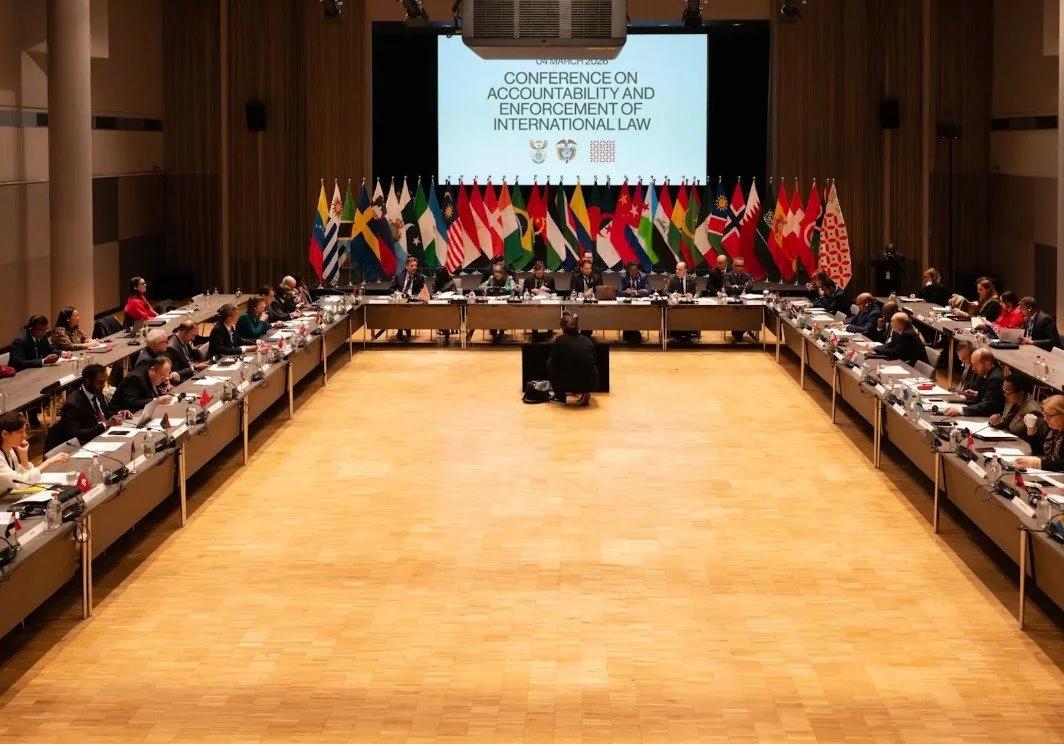
In January 2025, eight States from the Global South convened in The Hague and established The Hague Group — a coalition of States committed to coordinated legal and diplomatic measures in response to the Gaza war and the broader Israeli-Palestinian conflict. The initiative seeks to operationalise what its members describe as international legal obligations, including the duty not to recognise Israel’s occupation of Palestinian territory and to support the realisation of the Palestinian right to self-determination.
By March 2026, the group has seen the participation of forty States, including several European countries. Its members describe the initiative as “not radical”, but as a pragmatic response to a persistent enforcement gap: while institutions such as the International Court of Justice (ICJ) and the International Criminal Court (ICC) have issued opinions, orders, and arrest warrants, these have not translated into consistent State practice.
Rather than proposing new legal frameworks or seeking broad diplomatic consensus, the Hague Group focuses on coordinating concrete enforcement measures – including arms embargoes, prevention of the docking of ships with military cargo to Israel, and the review of public contracts – grounded in existing decisions of the ICJ and ICC and resolutions of the United Nations.
The issue is no longer the absence of legal norms, but the absence of mechanisms willing to enforce them. This article examines how the Hague Group might function as an enforcement mechanism, how it differs from competing frameworks, and what structural deficits currently limit its capacity to generate political and economic pressure.
